



Author Archives: Erik Smith

Dramatic increase in fuel prices, OK’d by Senate Democrats, would be ‘poison pill for agriculture,’ Dozier says

To see floor speech, click here.

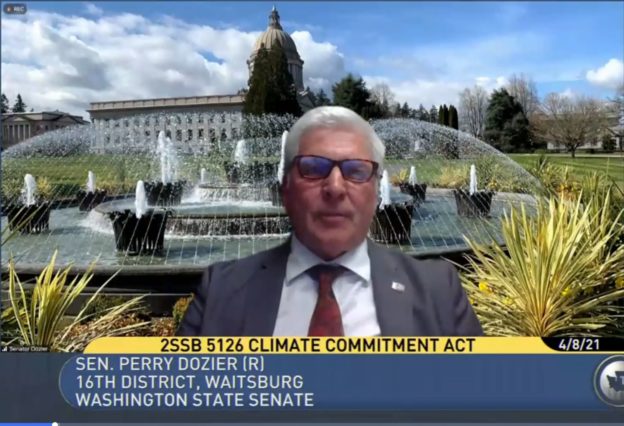
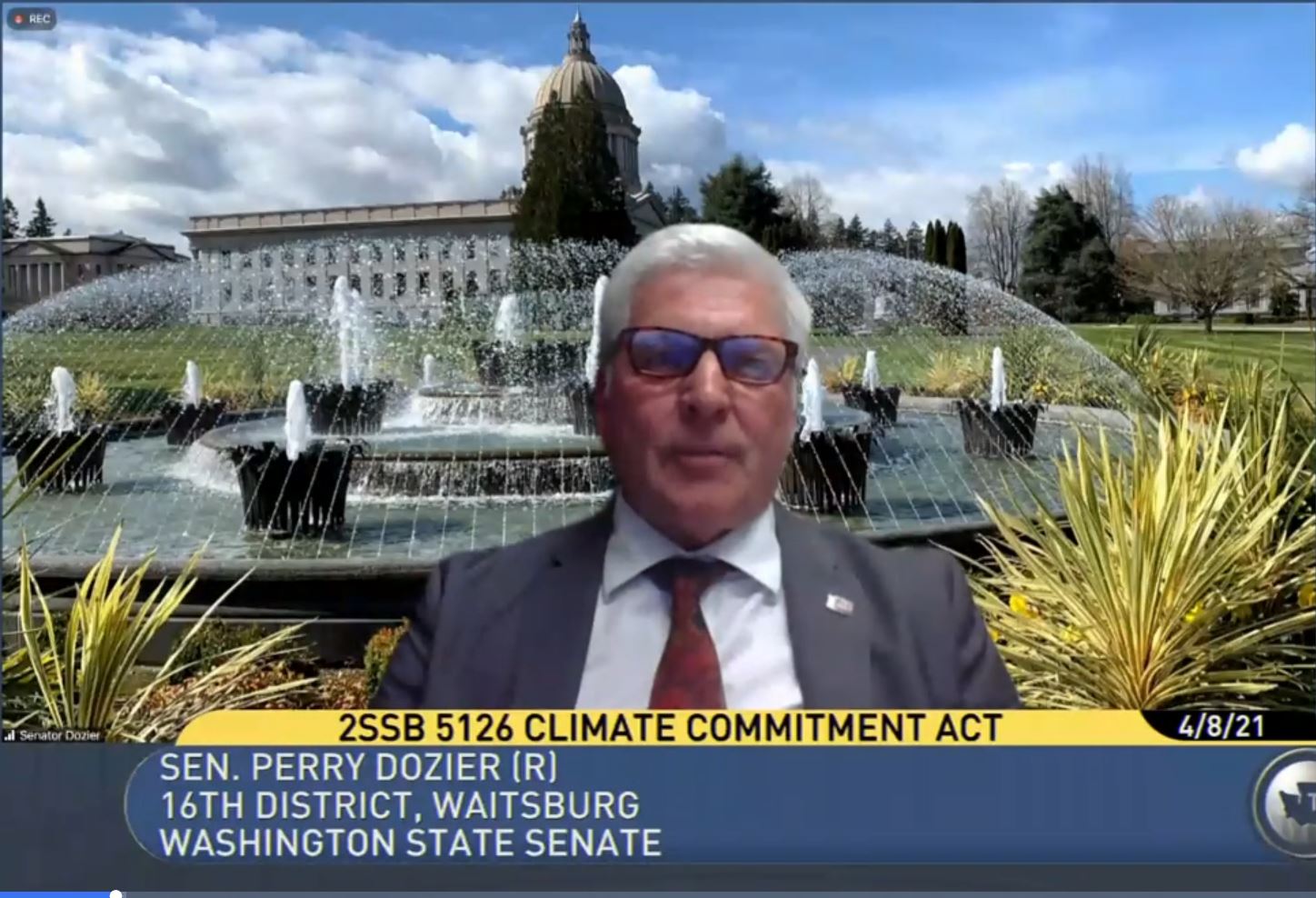
OLYMPIA – After Senate Democrats passed a pair of bills Thursday night that would cause gas and diesel prices to skyrocket, Sen. Perry Dozier is warning food costs would rise and small farmers would be driven out of the business.

Dozier, R-Waitsburg, a lifelong wheat grower, called the measures “a poison pill for agriculture” and said they would have the most profound effect on farming of any legislation passed in the last 40 years.

The steep increases in fuel costs are a top priority for majority Democrats in the Legislature this year. The two bills are expected to increase the cost of fuel about 55 cents a gallon by 2028, and nearly 80 cents at full implementation. The measures implement complicated schemes requiring manufacturers and other businesses to purchase “credits” and “allowances” to offset carbon emissions.

House Bill 1091, imposing a low-carbon fuel standards program on Washington, passed the Senate 27-20. Senate Bill 5126, imposing a cap-and-trade program, passed 25-24. Both measures go to the House for further consideration.

The big increases in fuel costs would come in addition to state and federal gas taxes of 67.8 cents a gallon, already the fourth highest in the country, as well as a 9.8-cent increase in transportation-related gas taxes under consideration by this year’s Legislature.

Dozier observed that agriculture is an intense user of fuel and other petroleum-based products including fertilizers. Higher costs will squeeze farmers, who are dependent on market prices for their crops.

“I have been doing this for four decades, living on a farm my entire life,” Dozier said. “I have been through the cycles that we find in agriculture – ups and downs and ups and downs. This will make the downs more prolific and the ups will be so softened we still may not profit.”

Dozier said artificially high fuel costs, forced by state-government mandates, would cripple the vitality of Washington agriculture, reduce the number of family-owned farms, and convince the young to seek other careers.

“The ground will still be farmed, but it will be farmed by much larger farmers,” Dozier said. “We’ll probably see a lot of young kids who won’t consider farming. I have two sons – they’re 24 and 26 – and I’ve encouraged them both to find other jobs and not come back to farming, because it is so volatile. I’m glad that both of them have good degrees and that they have jobs, because [farming] wouldn’t be a future for them.”

During Thursday’s fierce 8-hour debate on the bills, Republicans mounted stiff opposition, many pointing out that the new fuel mixtures mandated by the fuel standards measure tend to gum up older engines, such as those widely used in agricultural farm equipment. They noted that the measures would disproportionately affect the poor and those of low income, and that the bills would have no measurable impact on world climate.

After Dozier spoke on the floor against the fuel standards measure, Sen. Curtis King, R-Yakima, added, “We need to take it out in Sen. Dozier’s field and bury it.”


 

Sen. Dozier’s first bill becomes law, allowing mortgage originators to work from home

OLYMPIA – Freshman Sen. Perry Dozier’s first bill was signed into law Wednesday afternoon by Gov. Jay Inslee, a measure allowing mortgage loan originators to work from home.

Inslee added his signature to Senate Bill 5077 at a bill-signing ceremony Wednesday. The measure is the first from Dozier to earn a place in the state’s lawbooks. Dozier, R-Waitsburg, was elected to the Senate last fall from southeast Washington’s 16th Legislative District, and this is his first legislative session.

“It’s great to see your first bill become law, and it’s even better when it happens with unanimous support,” Dozier said. “But the legislation itself is always the most important thing. This bill establishes work-from-home standards for a business that must comply with extensive record-keeping requirements, and it will provide greater flexibility for mortgage loan originators and their customers.”

State law currently requires mortgage loan originators to work from licensed office locations. But the state Department of Financial Institutions has allowed them to work from home over the past year under COVID emergency orders. The measure permits originators to work from home if they adhere to state security rules, keep all paper records at their branch offices, and their work is done via a secure office computer system.

The measure passed the Senate 49-0 on Feb. 3, and it passed the House 98-0 on March 24.

Starter income tax is bad enough – what comes next is even worse

By Perry Dozier

The following op-ed appeared in the Prosser Record-Bulletin, Dayton Chronicle and other newspapers during the week of March 22, 2021.

Last week the Legislature got a terrific piece of news. State tax collections have rebounded despite one of the worst economic situations we’ve ever faced. The latest projection adds $3.3 billion, and we’re right back where we were before the COVID shutdown.

The strange thing about it was the reaction of our Democratic colleagues. They said they wouldn’t let this good news stand in the way of their brave and noble effort to impose an income tax on the people of Washington. And never mind that the voters keep saying no to the idea, 10 times since 1934.

It’s been like that all session long, as this year’s proposal for a new state income tax has advanced in the Legislature. Logic has been tortured, syntax twisted, elaborate subterfuges employed. Earlier this month, the Senate’s Democratic majority passed a starter income tax they insist would only hurt millionaires. But I think everyone understands that if this starter income tax survives court challenges, it is only a matter of time before it becomes a big, broad income tax that hits the middle class.

For the trusting souls who wish to believe this is only about the rich, I want to explain why this will lead to a middle-class income tax, as surely as night follows day.

Senate Bill 5096, proposed by the governor, enacts a narrow type of income tax, on capital gains. There are so many exclusions that it really leaves only one major target, high earners who are compensated with stock and options, mainly in the tech industry.

Some people may think it is a good idea to soak the rich, even if it means we must attack the industry that has driven the state’s prosperity for the last 25 years and give it an incentive to leave the state. Unfortunately, in every other state that has tried something like this, it hasn’t ended well.

The problem is called volatility. The Department of Revenue tells us to expect $1 billion every two years if this tax is enacted, but that’s just an average. Actual collections from capital gains income taxes go up and down like a roller coaster – anywhere from 200 percent of projections to a 91 percent decrease, according to the National Taxpayers Union. The reason is simple. No one sells assets in a down market if they can help it. They wait before cashing in their stock options.

So when recession hits, tax collections tank. Every state foolish enough to build budgets around this anticipated money – which is to say, all of them – has to find hundreds of millions in a hurry. Broadening the tax base is the easy way out. It happened in Connecticut, New York and New Jersey. Taxes on the rich became taxes on everyone within a few short years.

Right now, this bill appears to be on the fast track in the House, and nothing seems likely to stop it. I fully expect the people will have to take it to an initiative or referendum. When the people get their chance to vote against an income tax for the 11th time, I hope they’ll look beyond the platitudes to the experience of other states and the evidence they can see with their own eyes.

For instance, advocates of higher taxes and spending like to tell us our tax system is broken. It just doesn’t take enough of the people’s money. But if our system is so well-balanced it can produce a $3.3 billion turnaround in the worst of times, that sounds like a “problem” we would be crazy to fix.

Sen. Perry Dozier, R-Waitsburg, represents the 16th Legislative District.

‘Starter income tax’ will eventually hit middle class, Dozier says

Votes against income tax bill on Senate floor, as Senate Dems pass measure 25-24


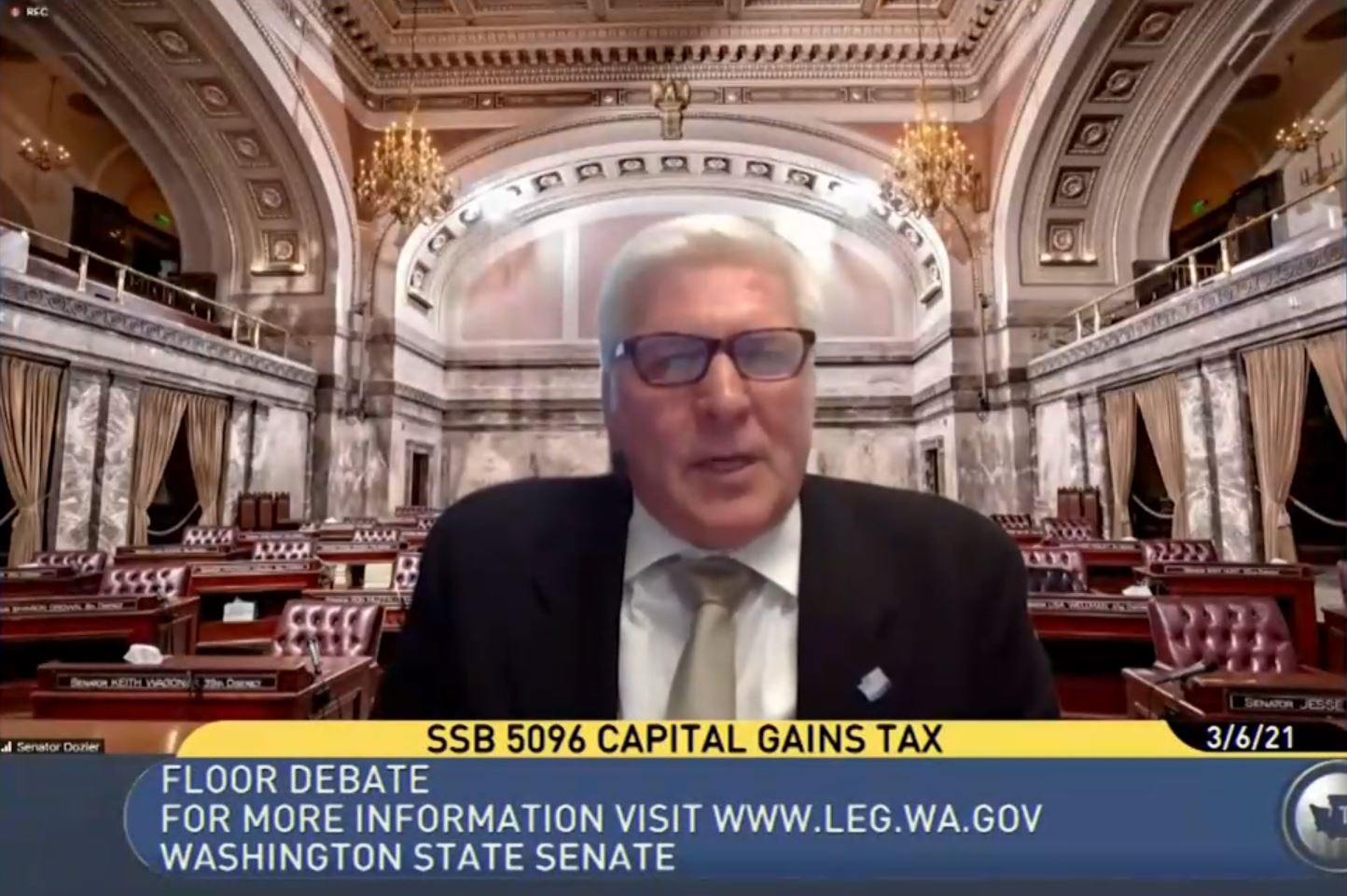
To see video from Senate floor debate, click here.

OLYMPIA – If the income tax bill passed by the Senate Saturday makes it into law, you can be sure it will grow and grow, and eventually hit the middle class, said state Sen. Perry Dozier, R-Waitsburg.

Dozier was among the 24 lawmakers who voted against the income tax in the Senate Saturday, including all members of the Senate Republican Caucus. But Democrats had more votes, and it passed 25-24. The measure now moves to the House for further consideration.

“I really feel that this income tax on capital gains is really just a starter tax that most likely will lead to a broader income tax in this state,” Dozier said.

The measure imposes a narrow income tax on capital gains over $250,000, capturing primarily income from highly compensated employees who receive stock options. But Dozier said the starter income tax sets the state up for a broader income tax, the moment there is a downturn in the economy. That’s because tax collections from high earners will plummet in the next recession. “In a down market, nobody sells,” he explained.

Meanwhile, the Legislature will write budgets that count on a steady flow of tax collections – about $1 billion every two years. So when tax collections fall, future legislatures would have to find hundreds of millions of dollars in a hurry. An expansion of the income tax would provide an easy solution. Dozier noted this is exactly what has happened in states with high-earner taxes – they don’t stay taxes on high-earners for long.

“Anticipated revenue will get you in trouble every time,” Dozier said.

He noted that the state of California recorded the biggest shortfall in its history last year — $54 billion – and that the Golden State’s governor, Gavin Newsom, told the press that the biggest reason the deficit was larger relative to other states was California’s overreliance on taxes on the wealthy.

Federal taxes on capital gains are steep enough without an extra state tax on top of it, Dozier said. He noted that his father in law purchased farmland north of Pasco in the ‘40s. When development approached and it was time to sell, federal taxes proved very stiff – about 40 percent of every payment has to be earmarked for taxes. “Forty percent – that’s an awful lot to lose each time due to taxes,” he said.

Dozier asked the Senate to imagine how much worse it will be if a new state tax is added.

“This is a lead-in to take away from the middle class, the people it hurts the most,” he said.


COVID: Governor’s plan to have a plan fails the state

By Perry Dozier

The following op-ed appeared in the Prosser Record-Bulletin and Dayton Chronicle during the week of March 1.

Three weeks ago, Southeast Washington dodged a bullet. Gov. Jay Inslee announced every other area of the state would move to Phase 2 of his COVID lockdown plan, allowing partial reopenings of restaurants, gyms, and other businesses.

But not ours, because of alarmingly high hospitalization rates.

It was a mistake. A single hospital in Walla Walla misreported its COVID figures. If it wasn’t for the eagle-eyed county officials who caught the error and brought it to the attention of the Department of Health, businesses from Ellensburg to Walla Walla might still be under the most stringent lockdown orders today.

Some might call this good news, because the mistake was discovered quickly and partial reopenings in our area started Feb. 15, just like they did in other regions of the state. But really we ought to see it as an indication of the arbitrary and troubling decision-making process we have seen from the governor’s office as it attempts to manage the outbreak with top-down decrees.

Today business owners and workers across the state are anxiously awaiting the governor’s next step. What goals must we meet to advance to Phase 3? He’s had seven weeks, and he still doesn’t have a plan.

At a news conference Thursday [Feb. 25], the governor said he plans to have a plan, but first he must plan a planning process to plan what ought to be in the plan. It might be soon. It might take weeks. That’s the plan.

We understand COVID is serious business, but I hope you’ll understand why those on my side of the aisle are skeptical of the governor’s claims that science governs every decision. We legislators represent our communities, and like every resident of the 16th Legislative District, I know it’s nearly a three-hour drive to Ellensburg, through mountains and sagebrush. Yet a non-existent spike in Walla Walla would have been enough to keep Ellensburg closed. There have been many other decisions that defy common sense.

Unfortunately, the Legislature – the people’s voice — has been shut out of the decision-making process. First, by the fact the Legislature was not in session when the outbreak began. Then, once we got to Olympia, the first important act of the majority party was to hand all authority to the governor.

So we need him to appreciate the reality beyond Olympia. There are really two death tolls in this pandemic. Thousands of businesses are closing permanently – 2,500 restaurants in the first six months alone. Now we’re seeing a ripple effect as these closures affect other businesses that support them.

And when businesses go under, jobs for working families go with them. The immediate issue is that Phase 2 permits only 25 percent occupancy of restaurants, gyms and entertainment venues. There is no scientific justification. They need to be at 50 percent to stay in the black. It’s time to increase capacity and move to Phase 3.

Recent reports from DOH and the Institute for Disease Modeling show that we can safely open schools. Phase 3 should include efforts to safely open our schools for in-person learning. It’s time.

We remain one of the most locked down states one year after the pandemic. Our COVID-19 cases and hospitalizations have been in sharp decline. More freedom must be a component of Phase 3.

Vaccinations are rising every day in the state. Our citizens, businesses, and schools are proving they can operate safely with appropriate masking, social distancing, and safety precautions. We must hope the governor recognizes the need for balance, and the danger to our economy. We expect leadership from the governor – and a plan would be a good start.

Sen. Perry Dozier, R-Waitsburg, represents the 16th Legislative District.

Let’s fix unemployment-insurance problems first before we create new ones

By Sen. Perry Dozier

Note: The following op-ed appeared in the Prosser Record-Bulletin and the Dayton Chronicle during the week of Feb. 8.

The meltdown at the state Department of Employment Security ought to teach us a lesson. It’s easy for government to create problems, not so easy for the Legislature to come back in and clean up the mess.

We ought to keep this in mind as the Legislature debates some of the big, bold ideas our liberal colleagues are bringing to the table this year – for an income tax, big increases in gas prices, greater government control of industry, and many, many more. Many of these policies are so big and so sweeping we can be sure they would open a Pandora’s box of unintended consequences.

When hundreds of thousands of Washington residents were thrown out of work last year by the edicts from the governor’s office that shut down the state economy, the assumption was that ESD would be able to handle the crisis effectively, distributing unemployment-insurance benefits to everyone who needed them.

Instead we saw fumble after fumble. In one of the most mind-boggling failures in Washington-state history, the agency paid out $600 million to Nigerian fraudsters. Legitimate applicants waited weeks and even months for benefits. Last week we learned the personal information of 1.6 million applicants was hacked and now no doubt is being used to commit even more financial fraud.

Incompetence is one thing. A bigger problem has to do with the way our unemployment-insurance system works. The governor’s emergency orders put so many people out of work that we drained our unemployment-insurance trust fund. Business owners across the state faced massive payroll-tax increases, even those who didn’t lay off a soul. Those who did were hammered even harder.

Without action by the Legislature, 81 percent of Washington small businesses faced at least a doubling of their UI taxes, according to a survey by the National Federation of Independent Business. Some 55 percent faced increases of more than 400 percent. We’ve heard about one business that got hit with a 1,500 percent increase. At a time when businesses across the state are closing their doors permanently, a hit of tens of thousands of dollars certainly would do many more of them in.

I wish I could report that we’ve solved that problem, but we really haven’t. Two weeks ago, the Legislature passed Senate Bill 5061, a complicated measure that spreads the hit out over the next four years. Unemployment taxes still will go up, but they won’t go up as much this year – and business still has to pick up the tab for a problem it didn’t create.

This was a challenging vote for me, but after much consideration I recognized we needed to start somewhere. Some of my Republican colleagues voted no, arguing that what we really need is an overhaul of the unemployment insurance system. I second that. Not only do we need to make sure our system works, we also need to make sure business is held harmless.

We can do that. We can tap our state’s “Rainy Day fund” to help restore the UI trust fund. We can commit that federal funds, if they come, will be earmarked for mitigation of this problem. So far majority Democrats in the Legislature have told us they’re willing to consider solutions like these. On my side of the aisle, we’re determined to make sure that promise is fulfilled.

The Legislature should learn from this experience. Our majority urban colleagues are convinced they can fix all the problems their big new proposals would create. Until we start seeing some genuine leadership to solve the problems now upon us, the Legislature should think twice before creating new ones.

Sen. Perry Dozier represents the 16th Legislative District.


Sen. Dozier passes first bill, allowing mortgage originators to work from home

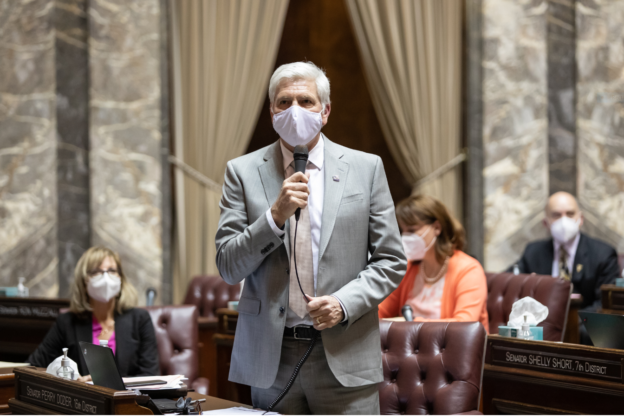
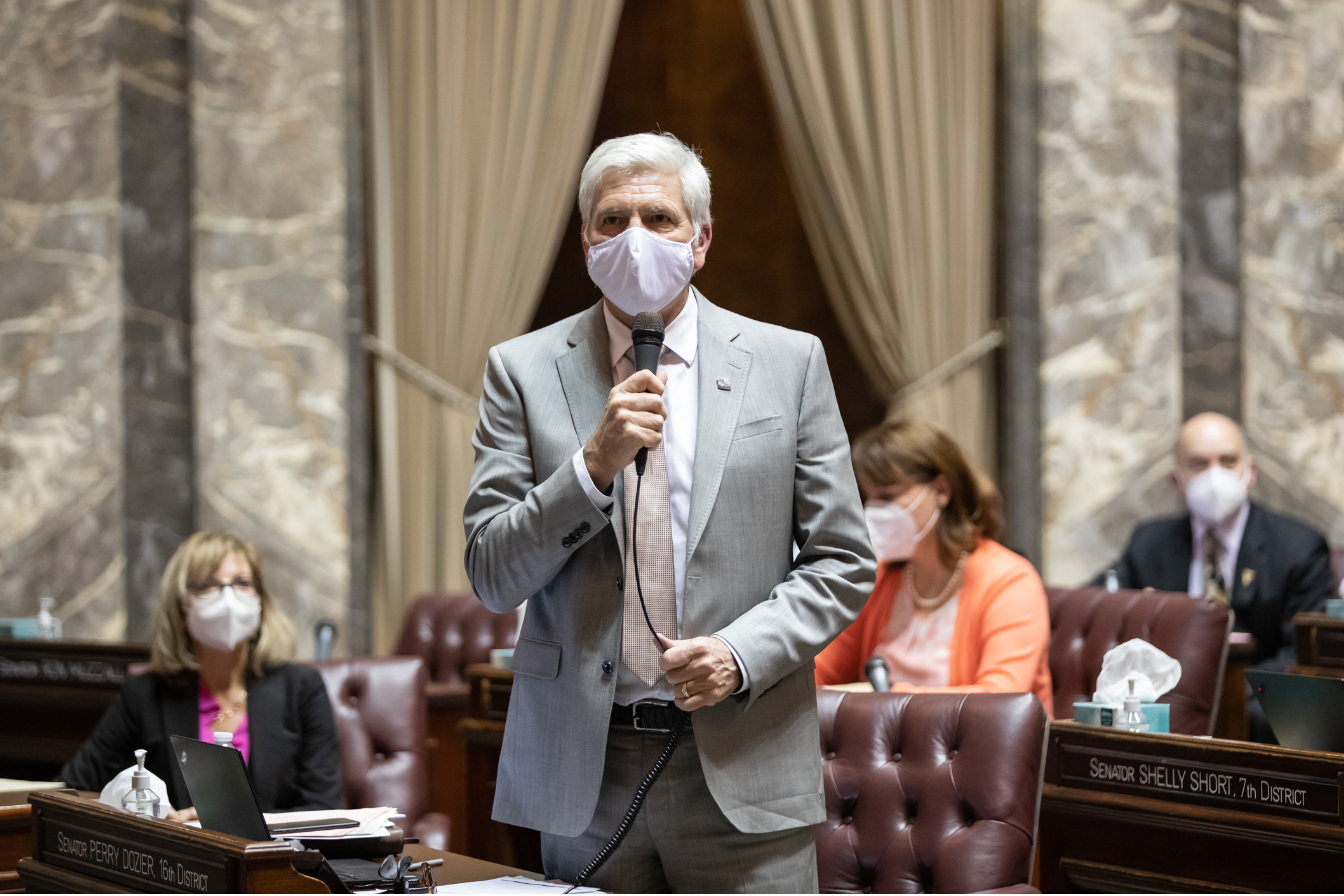
Sen. Perry Dozier speaks on the Senate floor Wednesday night. Due to COVID restrictions, only a handful of members are permitted on the Senate floor at any given time, and masks are required.

To see video of the first-bill festivities, click here.

OLYMPIA – Sen. Perry Dozier, R-Waitsburg, passed his first bill off the Senate floor Wednesday night – a measure that allows mortgage loan originators to work from home.

The occasion prompted much teasing from Dozier’s colleagues, in accordance with Senate tradition, as they denounced the bill and urged the full Senate to vote no. Yet when it came time for the roll call, the bill passed 49-0.

“It’s a tradition around here, and I’m glad to be part of it,” said Dozier, who took office at the start of this year’s legislative session. “It was as if the entire Senate rose up against me. But I know it’s all in fun.”

Senate Bill 5077 authorizes mortgage loan originators to continue working from home, a practice allowed for the past year by the state Department of Financial Institutions under COVID emergency orders. State law requires mortgage originators to do all business at licensed office locations. The legislation clarifies that working from home is permissible, if mortgage loan originators adhere to state security rules, keep all paper records at their branch offices, and their work is done via a secure office computer system.

Dozier said the additional flexibility should make it easier for clients to meet with mortgage originators and get their loans processed. The measure now moves to the House for further consideration.

Overwhelming support for safe-business-reopening bill shows economic recovery should be state’s top priority, Dozier says

Far more important than agenda-driven bills now under consideration by Legislature

OLYMPIA – A huge turnout for a Senate hearing on a bill to reopen shuttered restaurants, gyms and other businesses demonstrates economic recovery ought to be the Legislature’s top priority, says Sen. Perry Dozier, R-Waitsburg.

Some 1,620 people signed in Wednesday for a hearing on Senate Bill 5114, a measure that would move all of Washington to “Phase 2” of its COVID lockdown plan. The move would allow restaurants to resume indoor dining, reopen gyms and entertainment venues, and relax other restrictions. Social-distancing protocols would be maintained.

Dozier noted 93 percent of those who signed in favored the bill.

“When this many people come forward, the Legislature needs to listen,” Dozier said. “The people are telling us they need to get back to work.

“Our colleagues in the Democratic majorities in the House and Senate are eager to take votes this year on issues driven by an urban political agenda – on an income tax, cap and trade, proposals to artificially increase gas prices, and other ideas that will be hard for the people of Washington to swallow.

“These other issues are a sideshow, as far as the people are concerned. Our COVID economic shutdown has driven unemployment to record levels. The snarl with unemployment checks shows the state is unable to cope. We have businesses closing for good and idled workers wondering how they will put food on the table.

“This is the issue we need to deal with. This is an emergency. The sooner the Senate takes a vote on this bill, the better.”

Dozier, who took office when the Legislature began its 2021 session Jan. 11, has already taken a leading role on the issue. Last week he offered an amendment to a resolution on the Senate floor that also would have moved the state to Phase 2.

The proposals address the central problem with the state’s phased-lockdown plan. The criteria are so stringent that it could be many months before many small businesses are allowed to reopen. Yet business owners demonstrated they could operate safely during their brief respite last summer and fall, Dozier said.

During Wednesday’s hearing on SB 5114 in the Senate State Government and Elections Committee, restaurateurs, gym operators, bowling-alley owners and others testified that they have been pushed to the brink by months of no income and bills that keep piling up. They complained that the state’s arbitrary restrictions are based more on guesswork than science. Washington is one of just five states that continues to prohibit restaurant indoor dining.

“This is coming from every part of the state,” Dozier said. “Today the Legislature heard from people everywhere, from Seattle, Olympia, Spokane, Bellingham, Vancouver and Kennewick. I hope the Democratic majority will permit a vote in committee and allow this important bill to advance to the Senate floor. This isn’t like the income tax. This is something the people actually want us to do.”

Our biggest challenge: Restoring trust in government

By Sen. Perry Dozier, Rep. Mark Klicker, Rep. Skyler Rude

Note: The following op-ed appeared in the Prosser Record-Bulletin and Dayton Chronicle during the week of Jan. 18.

This week a new delegation of legislators from the 16th District began the 2021 session. The 16th District stretches from Prosser to Dayton, the Tri-Cities to Walla Walla, and covers diverse industries and populations.

In the 16th District, two of us are new. Sen. Perry Dozier, a dryland wheat farmer from Waitsburg, succeeds Maureen Walsh, who represented the district for 16 years in the House and Senate. Rep. Mark Klicker, a Realtor and forest manager from Walla Walla, succeeds Bill Jenkin, who served two terms in the House.

Our returning member is Rep. Skyler Rude of Walla Walla, first elected to the House two years ago after long experience on the legislative staff.

Our district has a long history of working cooperatively, listening to the voices of the community, and working toward pragmatic solutions by putting partisanship aside. This collaborative spirit is going to be critical over the next few months

Our 2021 legislative session opened Jan. 11 in Olympia, and clearly we have urgent issues that require our attention. The COVID outbreak and resulting economic shutdown have created enormous problems.

In addition, one of our biggest challenges is to restore faith in government after one of the most trying episodes this nation has ever faced.

Families are struggling and jobs are disappearing as some small businesses close their doors permanently. We need to straighten out the mess at the Employment Security Department that delayed unemployment benefits for so many and allowed massive losses due to fraudulent claims. We need to stave off crippling increases in unemployment insurance taxes that could push more businesses toward closure. We also need to maintain core government services as we bring our spending in line with tax collections – which thankfully remain healthy even at a time like this.

Your voice will be more important than ever, as there will be no opportunity for in-person advocacy efforts. Most legislators won’t be allowed to work in the Capitol, as session operates in a virtual environment.

Unfortunately, we are already seeing a renewed push to move highly controversial bills that may not get the same traction in ordinary times.

This year, we’re seeing proposals for a capital gains, which is a concern in part because it could be expanded to a general income tax if it survives court challenges. Voters have said no to an income tax 10 times on the ballot.

Another proposal would enact low-carbon fuel standards, which could result in an estimated increase of 57 cents per gallon of gas. We must be cognizant of the financial impact on working families as our state works toward a green economy.

We strongly disagree with these proposals, as do many of the residents of the 16th District. But there’s a bigger issue involved. Taking advantage of the situation to pass bills like these will only increase the public’s distrust of government. Prioritizing transparency and public input must be paramount.

At a moment when distrust of government is at an all-time high, we also want to take the opportunity to call out and condemn all political violence. As we debate issues important to Washington families, we must remember representative democracy requires dialogue and respect for our democratic institutions. With that in mind and despite the mostly virtual session, there are effective ways for the public to connect and be heard. Expanded remote committee testimony has made the legislative process more accessible in many ways. Please take that opportunity to make your voice heard by engaging in testimony at www.leg.wa.gov.

We are here to serve you and welcome your input. Please stay connected using the contact information below.

The 2021 Legislative session opened Jan. 11 and runs for 105 days. During the session, here’s how you can reach us: